A picture round need not depend on recognizing a celebrity, reading tiny lettering or seeing a particular shade. This original round uses arrangements of ordinary shapes. Each question has a picture and a text counterpart supplying the same relevant information. The player still has to solve the question; the counterpart does not simply announce the answer. Use either version, or both together, and keep the answer key out of view until everyone is ready.
Set out the round before revealing the key
Give each person six numbered answer spaces and show the panels one at a time. Alternatively, let a small team discuss each question without keeping competitive scores. These are suggested household arrangements, not a tested learning exercise or a formal accessibility certification. No specialist knowledge or purchased question bank is needed.
Read the exact question with either version of its clue. Do not add an extra hint to one version unless everyone can use it. A player can ask for the words to be repeated or take more time. If the picture is displayed across a room, make it large enough to inspect rather than assuming a phone-sized image will work for everyone.
W3C's complex-image tutorial distinguishes a brief identification from a fuller text representation of the essential information. That web guidance informs the way these counterparts preserve arrangement, sequence and position. It does not certify this household game, and writing only “some shapes” would not convey the information needed to play.
Questions one to three: count, continue and increase
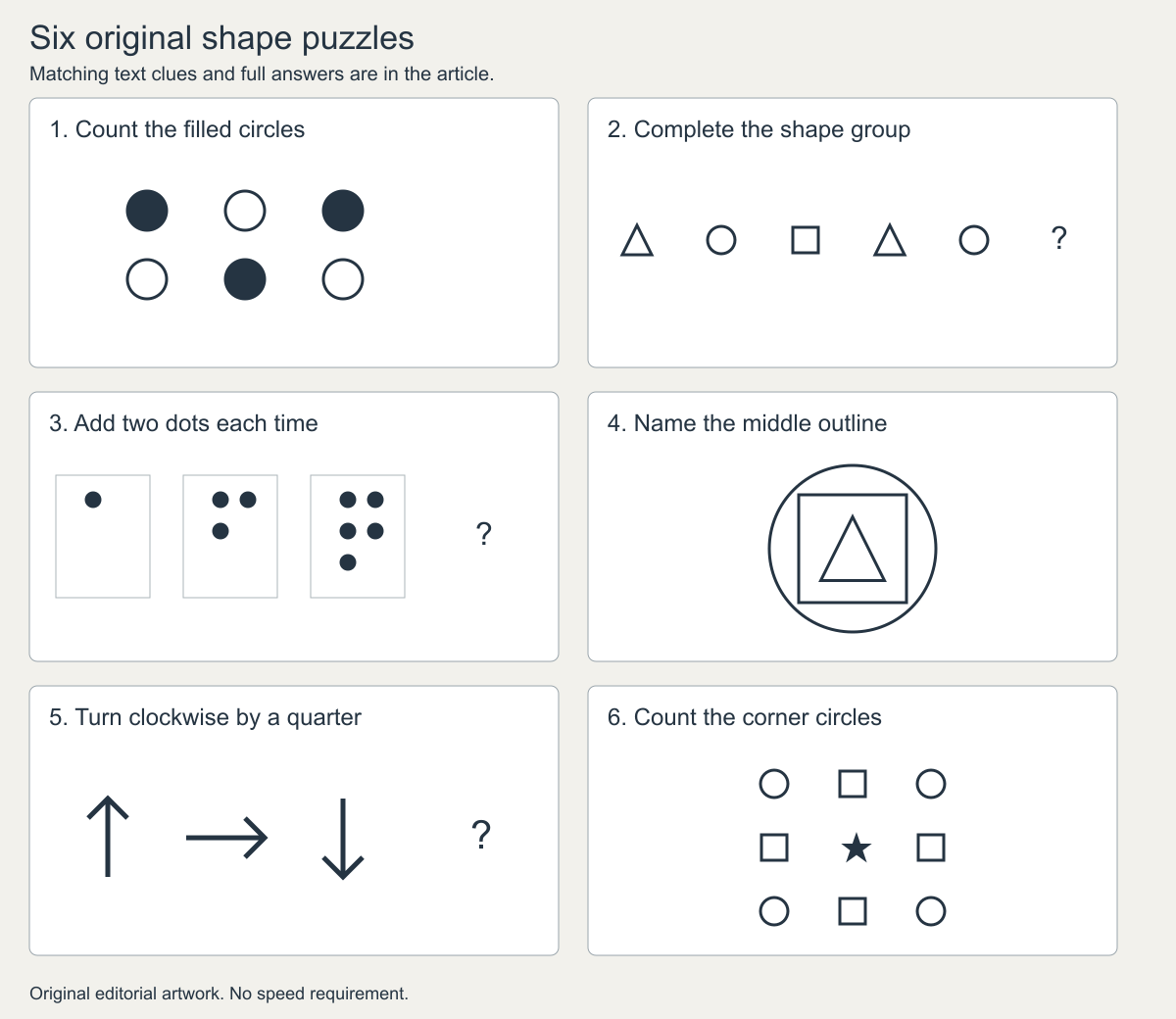
Question 1 asks: how many filled circles are there? The picture has two rows of three circles. Text counterpart: the top row is filled, outline, filled; the bottom row is outline, filled, outline. Count only the filled circles. Filling is the clue; a difference between two colors is unnecessary.
Question 2 asks: which shape completes the repeating group? The picture shows a triangle, a circle, a square, a triangle, a circle and a question mark. Text counterpart: the sequence is triangle, circle, square, triangle, circle, blank. Continue the same three-shape group. The question concerns shape, not the size of the symbols.
Question 3 asks: how many dots belong in the next group if the count increases by two each time? Three separated groups contain one dot, three dots and five dots. Text counterpart: group counts are 1, 3, 5, then a blank group. The stated increase is part of the question; players need not guess among unlimited possible mathematical rules.
Questions four to six: nesting, turning and position
Question 4 asks: which shape is in the middle of the three nested outlines? The outer outline is a circle, inside it is a square, and inside the square is a triangle. Text counterpart: circle contains square contains triangle. “Middle” means between the outermost and innermost outlines, not the point at the exact geometric center.
Question 5 asks: which direction comes next when each arrow turns one quarter-turn clockwise? The picture shows up, right, down, then a blank. Text counterpart: upward arrow, rightward arrow, downward arrow, blank; continue the stated clockwise turns. Keep the direction words available rather than requiring a player to identify a small rotated symbol.
Question 6 asks: how many corner positions contain circles? The picture is a three-by-three grid with circles at the four corners, squares in the four other edge positions and a star at the center. Text counterpart: top row circle-square-circle; middle row square-star-square; bottom row circle-square-circle. Count corner circles rather than every non-square symbol.
Reveal a reason with each answer
The answers are 1: three filled circles; 2: square; 3: seven dots; 4: square; 5: left; and 6: four circles. In question 1 the top row contributes two and the bottom row one. In question 2 the triangle-circle-square group repeats. Question 3 adds two to five.
For question 4, the square lies between the circle and triangle in the nesting order. For question 5, another clockwise quarter-turn takes down to left. For question 6, the four corners each contain a circle; the center star is not a corner. These explanations belong with the key so a later host can check what each question actually asks.
If a drawing is reproduced badly or a clue is read incorrectly, repair that question before comparing scores. Changing a shape after someone answers would change the puzzle. Save the original six panels and their matching wording together, and adapt the pace to the people playing rather than treating a fast answer as the only successful participation.
Sources & further reading
Published sources for the details and examples discussed in this story.