Four folded paper strips can give a pretend box robot a distinctive outline without making it a machine. This adult craft adaptation draws on Crayola’s complete Accordion Arm Robot lesson, checked November 10, 2026. The character and ten-line exchange below are original. No physical robot has been made or performance tested here, and the project is a small decorative character rather than a wearable or functioning device.
Choose the box and materials for an adult project
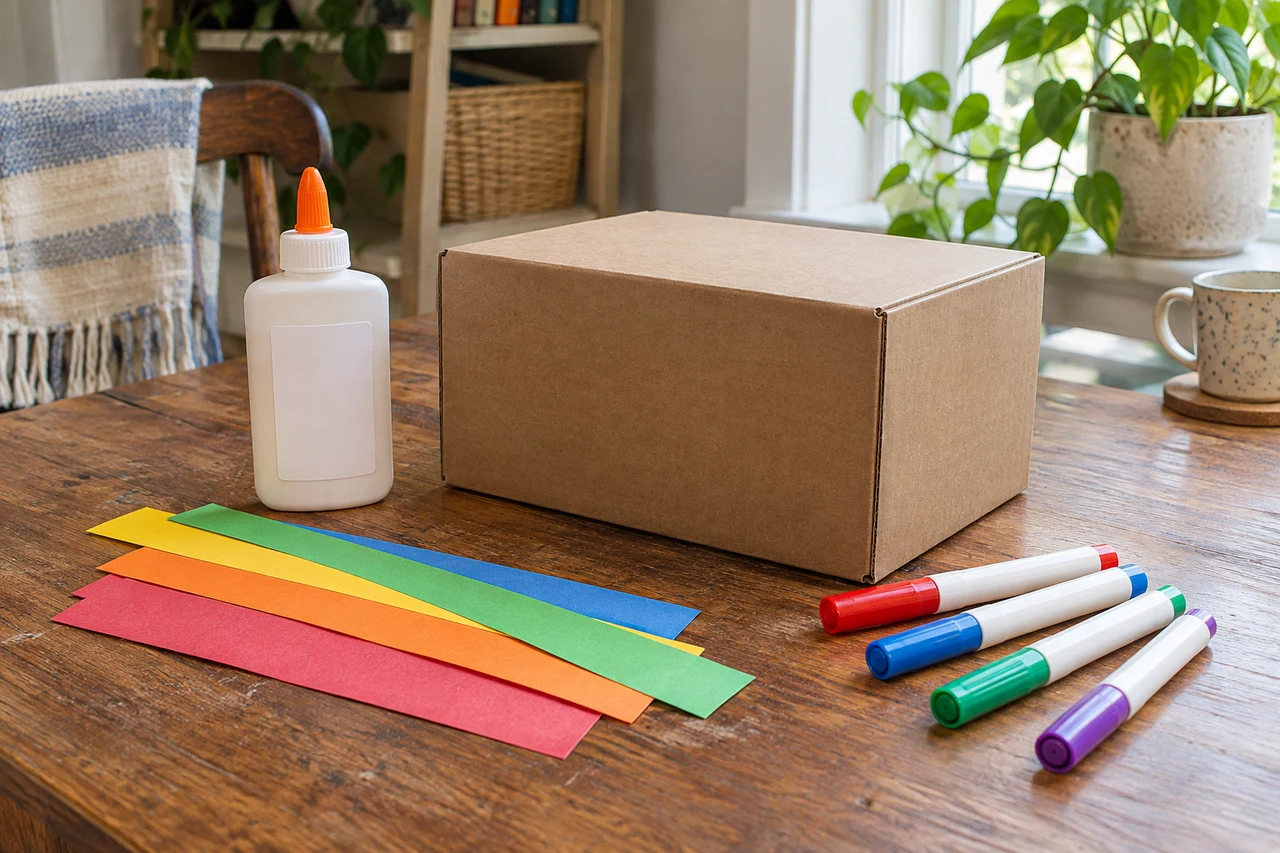
Gather one clean, empty cardboard box, suitable plain paper, markers and an adhesive intended for the actual paper and cardboard. Use a box whose existing closed shape supplies the body; the proposal needs no opening cut for a head or hand. Follow the tools’ and adhesive’s actual instructions and keep the materials separate from food.
Crayola’s lesson specifies Color Wonder paper and markers. This adult adaptation uses paper and coloring materials selected for the actual project; it does not claim that every marker works on every coated sheet. Check that the chosen materials suit each other rather than buy a large mixed kit on the assumption that everything labeled craft is interchangeable.
Cover the body and draw the character
Tear suitable paper to cover the box faces, attach it with the selected adhesive and allow it to set as the product directs. Do not invent a universal drying interval. Keep the box’s original structure intact rather than make it support an adult, hang from a fixture or carry a load.
Draw a face on one broad face, with a simple rectangular mouth and two different-sized eyes if that interests you. Add drawn buttons and a small square panel below the face. The details are original marks, not a copied robot from a film or Crayola’s artwork. Draw them instead of attaching loose toy pieces.
Add the four folded strips
Tear four long paper strips: two for arms and two for legs. Add simple marker bands and let the medium dry according to its directions before folding. Fold each strip back and forth into an accordion, with consecutive folds reversing direction. No particular strip width, fold count or finished span is guaranteed by this proposal.
Attach one end of each arm to a side of the box and one end of each leg to the lower front, following the adhesive directions. Let the joins set before handling. The paper folds provide the limbs’ zigzag outline. They are not powered joints, a moving mouth or proof that the character can stand on those strips. Rest the box body on a suitable surface.
Read A Robot Sorts the Silence
One adult can read both voices, or two willing adults can take a voice each. The robot can remain still while the words supply the action. This complete ten-line exchange has not been timed or performed for the article.
Robot: I have sorted the red paper and the blue paper.
Visitor: What will you sort next?
Robot: The silence. It is taking up the whole room.
Visitor: Does it need a box?
Robot: I cannot find its corners.
Visitor: Perhaps it is room for something.
Robot: For a noise?
Visitor: For deciding whether we want one.
Robot: Then I shall leave it where it is.
Visitor: Sit with me; we can keep it company.
Keep the ending modest
After reading, put the materials and tools away appropriately. The character can remain a dry tabletop decoration if the actual materials and setting suit it. It has no child-development, therapeutic or demonstrated durability outcome. Before buying more supplies, decide whether another face or a different final reply is the next change you actually want.
Sources & further reading
Published sources for the details and examples discussed in this story.