A game of Old Maid needs more than an odd card: it needs a clear account of what happens when players run out of cards. This feature selects John McLeod’s complete published version on Pagat. The hosting arrangement and partial-hand fragments are original proposals, not a played game or a tested teaching method. It does not combine another publisher’s penalties with these rules.
Use the selected rules, including leaving play
Pagat’s John McLeod describes two or more players using 51 cards: remove one queen from a standard pack. Deal all cards clockwise; unequal hand sizes are acceptable. Discard equal-rank pairs initially. The dealer begins by offering a face-down fan to the left-hand player, who takes an unseen card and discards any pair it makes. That player then offers their hand leftward.
Anyone who empties their hand is safe and takes no further part; play continues with the next remaining player. Eventually only the unmatched queen remains, and its holder loses. This is Pagat’s published version, not a manufacturer standard or a mix of regional variants.
Give a practice fragment a limited job
In an invented fragment, Ben draws a nine while holding another nine and discards the pair. In a separate fragment, an emptied hand leaves active play. Neither fragment is a complete deal.
For an original three-person introduction, explain the selected version before distributing cards. Agree whether the first hand is practice. Keep a demonstration separate from a scored or final round so that one person does not inherit an unexplained rehearsal advantage. No stakes, penalty system or developmental benefit is proposed here.
Keep the removed card separate from the game
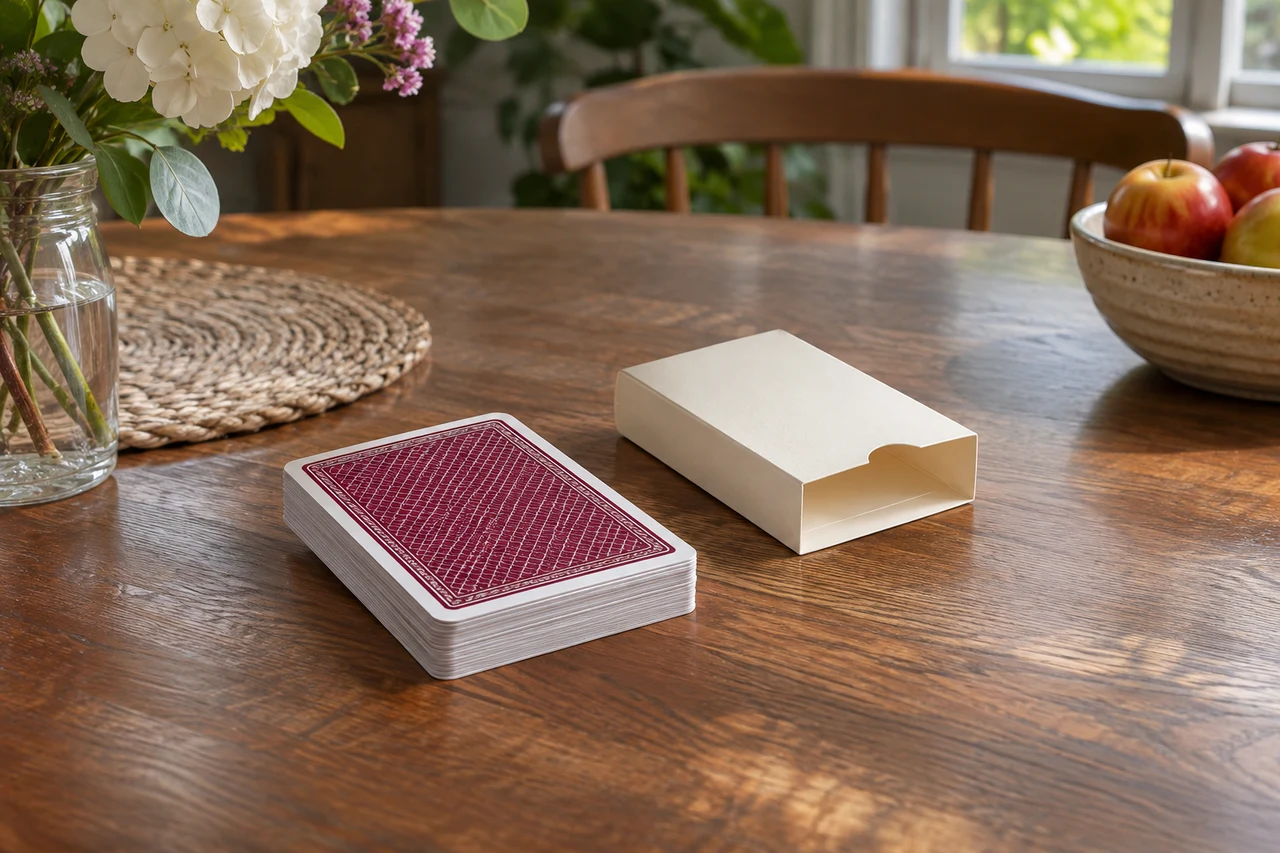
Before a real round, establish that the actual ordinary deck is complete, then keep the deliberately removed card clearly outside the playing area. A suitable empty deck box can give that card one identifiable place. The practical distinction is between something excluded by the selected rules and something accidentally missing.
Give discards their own area, separate from private hands and the card kept aside. Check that the actual participants can manage their cards without showing faces unintentionally. The layout is a proposed hosting arrangement, not a tested table size or a claim that every person needs the same accessory.
Let the result remain small and the purchase specific
A round can end without becoming a judgment about a participant. Agree how the group wants to move on afterward, whether that means another round or another activity. This adds no new winning condition to Pagat’s version and no compulsory forfeit. A familiar game name does not require recreating every family custom remembered with it.
A suitable standard deck may already provide what is needed. If considering a dedicated matching-card pack, inspect its actual contents and own rules rather than assume it is identical to this 51-card version. We have compared no deck artwork, readability or durability. Buy for an observed difficulty, not a promise that a more elaborate box will make the evening work.
Sources & further reading
Published sources for the details and examples discussed in this story.