A spoken rank and a hidden card can disagree in I Doubt It. This proposed three-adult evening follows Bicycle’s published game. The teaching fragments are invented, not a played deal, a strategy test or advice about truthfulness outside a card game.
Prepare the whole pack and the shared space
Use a standard 52-card pack. Deal left, two or three cards at a time, finishing the final cards one at a time. All cards are dealt; there is no stock.
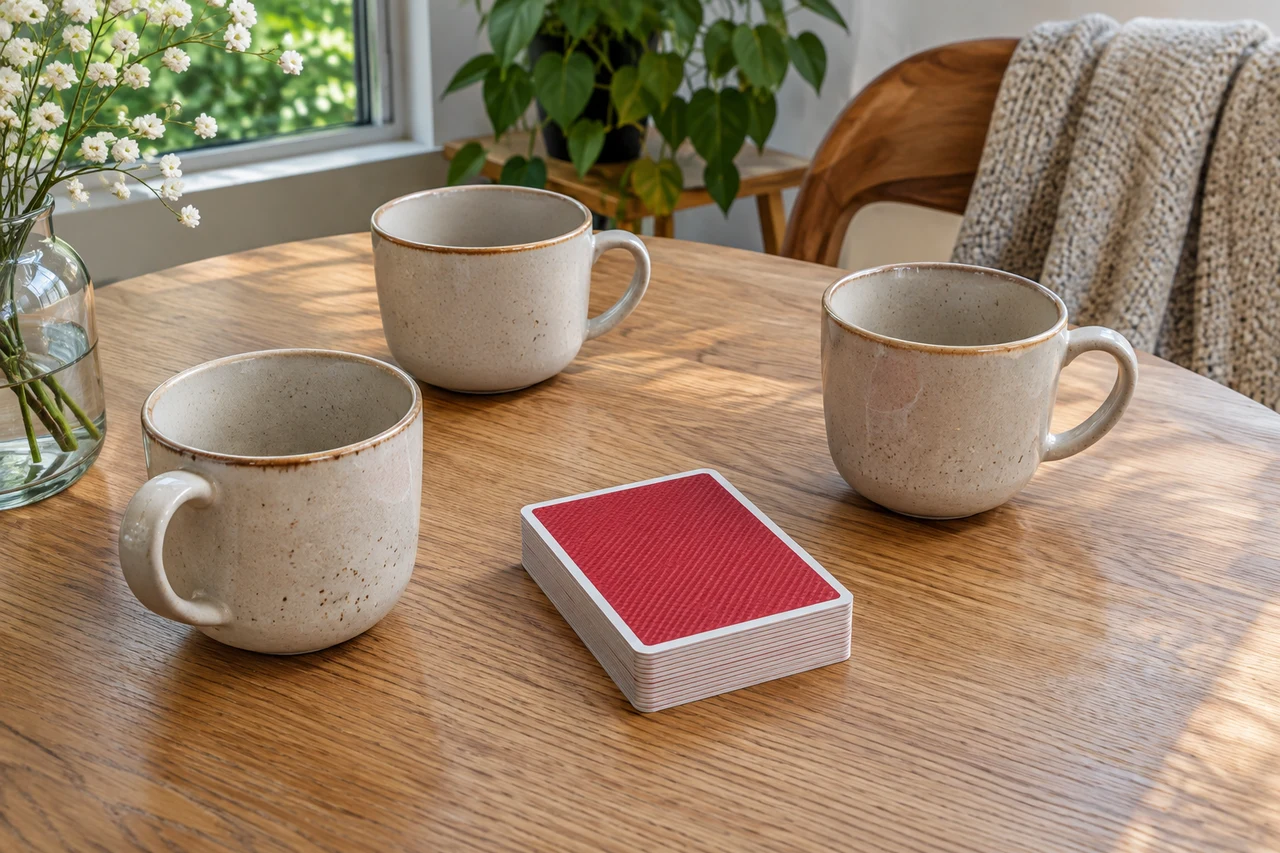
For this proposed evening, use a complete ordinary deck and a clear central space everyone can see and reach. Agree who deals and make the rank sequence available in words before starting. A special bluffing-game kit or a second deck is not required. Check that the participants actually want this kind of game rather than presenting it as a universally enjoyable family activity.
Keep the declaration distinct from the hidden cards
Following Bicycle, the player left of the dealer puts down one to four face-down cards, declaring that number of aces. Play passes left through twos, threes and onward to kings, then returns to aces. The declaration need not be true. Any player may challenge it. Reveal the current played cards: a correct declaration makes the doubter collect every table card; a false declaration makes its announcer collect them. Without a challenge, the cards stay face down. The first player to empty their hand wins only if the last declaration is unchallenged or challenged and correct.
Keep the current declaration’s cards identifiable when they are revealed. This proposal adds no scoring system, payment or priority rule for simultaneous challenges. Settle the chosen version before anyone is asked to rely on it.
Use two fragments without inventing a full deal
In one invented fragment, two aces are announced as two aces; in another, two queens receive that same announcement. A challenge exposes a correct declaration in the first and a false one in the second.
Those fragments do not specify where the other 50 cards are or imply that an actual game has been played. Return any physical demonstration cards to the complete deck before dealing. Keep the demonstration separate from the actual session so the first player does not inherit an unexplained claim or penalty.
Let the final declaration finish the game
Wait for the current claim to be resolved before packing up. Do not introduce a bonus for a particularly convincing performance or turn the card game into a test of someone’s character. The table can stay a place for an agreed game rather than an unsolicited judgment.
Before buying accessories, identify a real practical difficulty: holding a hand, seeing ranks or keeping the central pile distinct. This proposal has not tested card holders or a particular deck’s readability. The evening can end after one complete game; a second begins with a fresh deal. Its intended appeal is the agreed contrast between hidden cards and spoken claims, rather than a promised duration, skill benefit or reliable winning approach.
Sources & further reading
Published sources for the details and examples discussed in this story.