A paper game can give an evening a clear beginning and end without adding another box to the cupboard. This proposal uses NRICH’s published Put Yourself in a Box game and a deliberately small board. The board size and hosting arrangement below are our choices; no game has been played or teaching result measured for this article.
Make the whole board before the first move
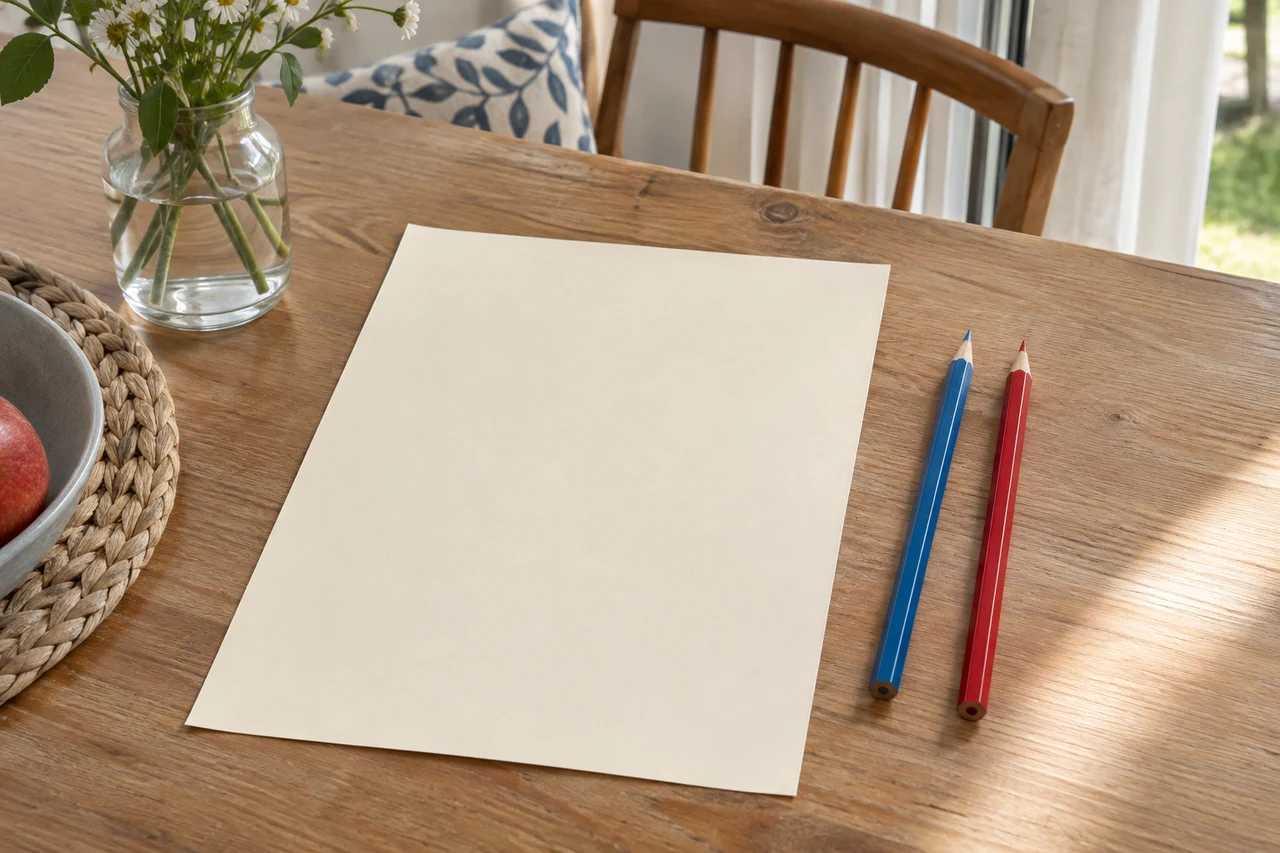
For two players, prepare paper and two differently colored pencils appropriate to the participants, following their directions. Draw four evenly spaced rows of four dots, aligned in columns. Leave enough room between neighboring dots for a short line and an initial inside a completed square. No printed commercial board or downloaded artwork is needed.
Four rows of dots make three spaces down, and four columns make three spaces across: nine small squares are available. This is elementary arithmetic for our chosen board, not a claim that NRICH requires this size. Keep the sheet in one orientation throughout the game so nobody needs to reinterpret the drawing halfway through.
Explain the rule that changes a turn
NRICH describes alternating horizontal or vertical lines between neighboring dots, never diagonals. A player completing a box writes their initial inside and takes another turn, continuing while they complete more boxes. The aim is to claim more squares than the other player.
Begin with no connecting lines. Add one previously undrawn edge at a time. When no new box is completed, the other player draws. When all edges are drawn, count the initialed boxes. Those stopping and counting instructions make explicit the finite-board consequence of the stated aim; they introduce no bonus, penalty or extra scoring category. If one edge closes two neighboring boxes, both newly closed squares receive that player’s initial, followed by one next line.
Show a turn without handing over a strategy
On a separate scrap, draw one square with three sides. Add its fourth side in one player’s color, put that player’s initial inside and point to the next line they may draw. Explain that this next line could also close a box, or could end the sequence without doing so. The extra turn follows the completed square, not a particularly attractive drawing.
Keep that demonstration separate from the real board. Do not quietly give one player a head start by leaving the example box on the playing sheet. This article supplies no winning strategy, best opening or tested difficulty rating. People can discover their own choices while keeping the same rules for both sides.
Count what is on the finished sheet
At the end, count all nine marked squares once. The two counts should total nine; a missing initial calls for checking who drew the relevant closing side, rather than inventing a new bonus. With nine boxes divided between two players, equal whole-number totals are impossible. That fact belongs to this board size, not every possible dot grid.
Before buying a reusable board, decide whether a pencil sheet already suits the group. A wipe-clean surface would also require its own suitable markers and care instructions; it does not improve the rules simply by looking more permanent. A second game can use a fresh sheet, with the first board retained if the players want to discuss it. No speed, learning or family-enjoyment result is promised.
Sources & further reading
Published sources for the details and examples discussed in this story.