A box of family papers can reach its next keeper with all the sheets present and their relationships missing. A small handoff should transfer enough context to understand what is there, while leaving uncertain dates and ownership questions unresolved. The fictional example below concerns ordinary stable paper letters and a notebook, not photographs, damaged material or a professionally appraised archive.
Agree what is actually changing hands
Imagine Lee offering a relative two existing groups of letters and one bound notebook. Before moving them, the two people agree whether the recipient is receiving the originals for keeping or only borrowing them for a defined purpose. This is an original household conversation, not a legal transfer form or a determination of ownership.
They also agree the intended private destination and whether anyone else may be given access. Physical possession does not itself establish copyright or permission to publish another person’s words. If those questions matter, obtain suitable advice and actual permission rather than treating a handwritten box label as clearance. A narrower handoff can leave future publication undecided.
Keep the existing groups understandable
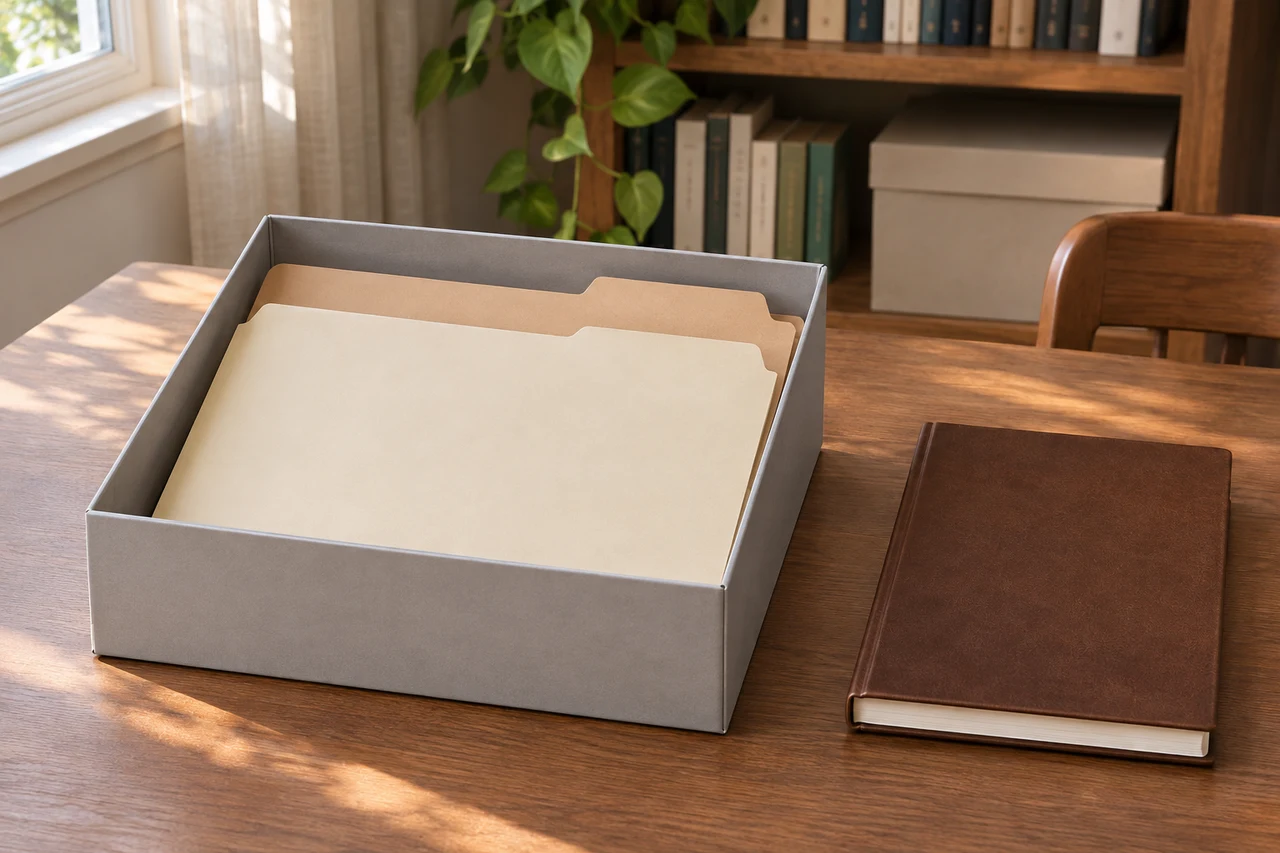
Lee’s fictional list can read: “Group A: letters already together in the blue folder; dates not checked. Group B: letters already together in the cream folder; sender attribution unconfirmed. One bound notebook; contents not fully reviewed.” These are original example descriptions, not a catalogue of real people’s records.
Do not rearrange every sheet into a guessed chronology simply to make the list look complete. Preserve the existing group descriptions and record any uncertainty. The receiver can then distinguish what came together from what a later person inferred. Keep private names or contents out of a public inventory, and avoid adding unrelated sensitive household records to the box.
Prepare a suitable place for the papers
National Archives handling guidance calls for a clean clear work area, no food or drink nearby and clean lotion-free hands for paper. Its storage guidance recommends appropriately sized acid-free, lignin-free or buffered housing that avoids bending and overstuffing, away from water risks and unsuitable damp or hot spaces.
For this stable paper-only example, compare the actual folder and box fit without folding a letter to suit a decorative container. Keep the bound notebook separate enough that loose sheets are not forced under it. This article gives no repair method for tears, mold or brittle material and no instructions for handling photographic media. Material needing special care calls for appropriate specialist guidance.
Complete the receiving check together
At the fictional handoff, the recipient compares the two existing groups and notebook with the private list and notes any discrepancy before the giver leaves. They identify where the list will remain and what question still needs an answer. A check can establish agreement about the described contents without claiming every page has been read or authenticated.
Before buying archival supplies, identify the actual dimensions, material types and storage conditions. A matching decorative set does not prove suitable housing. The completed handoff is modest: the intended recipient, the papers described, their existing relationships and the open questions remain connected. Later research can improve that description without silently rewriting what was known at transfer.
Sources & further reading
Published sources for the details and examples discussed in this story.