Crazy Eights becomes confusing when a familiar name brings several remembered games to the table. This feature selects Bicycle’s published version, rather than adding action-card penalties from elsewhere. Its object is to empty a hand. The original hosting plan and small examples below have not been played or tested; they make the chosen rules easier to discuss before the first deal.
Keep this version together
Bicycle uses a standard 52-card pack. Deal five cards each, one at a time from the dealer’s left. The rest forms face-down stock. Turn up a starter; bury an eight in the pack and turn another. Play starts left of the dealer. Play one card matching the top discard’s suit or rank, or an eight declaring a suit. After an eight, play that suit or another eight. If unable to play, draw until able or stock runs out; if still unable, pass. Drawing is permitted even with a playable card.
First to empty a hand wins, collecting remaining-hand values: each eight 50, K/Q/J/10 each 10, ace 1, others their pips. This is Bicycle’s stated version. It supplies no general deadlock resolution; if everyone is blocked, pause and consult an agreed complete rules source rather than invent a winner.
Give an example a clearly limited job
For an invented fragment, a club can follow a queen of clubs; a queen of hearts can also follow it. An eight may instead declare diamonds. These examples illustrate a match and a declared suit without claiming a complete legal deal, a recommended strategy or a played result.
The host can explain the selected rules before distributing the actual cards. Ask whether anyone remembers a different version, and settle that disagreement now. A remembered exception should not become binding only when it would help the person who remembers it. This feature adds no reverse, skip, stacked penalty or final-card announcement rule.
Keep the two shared piles distinguishable
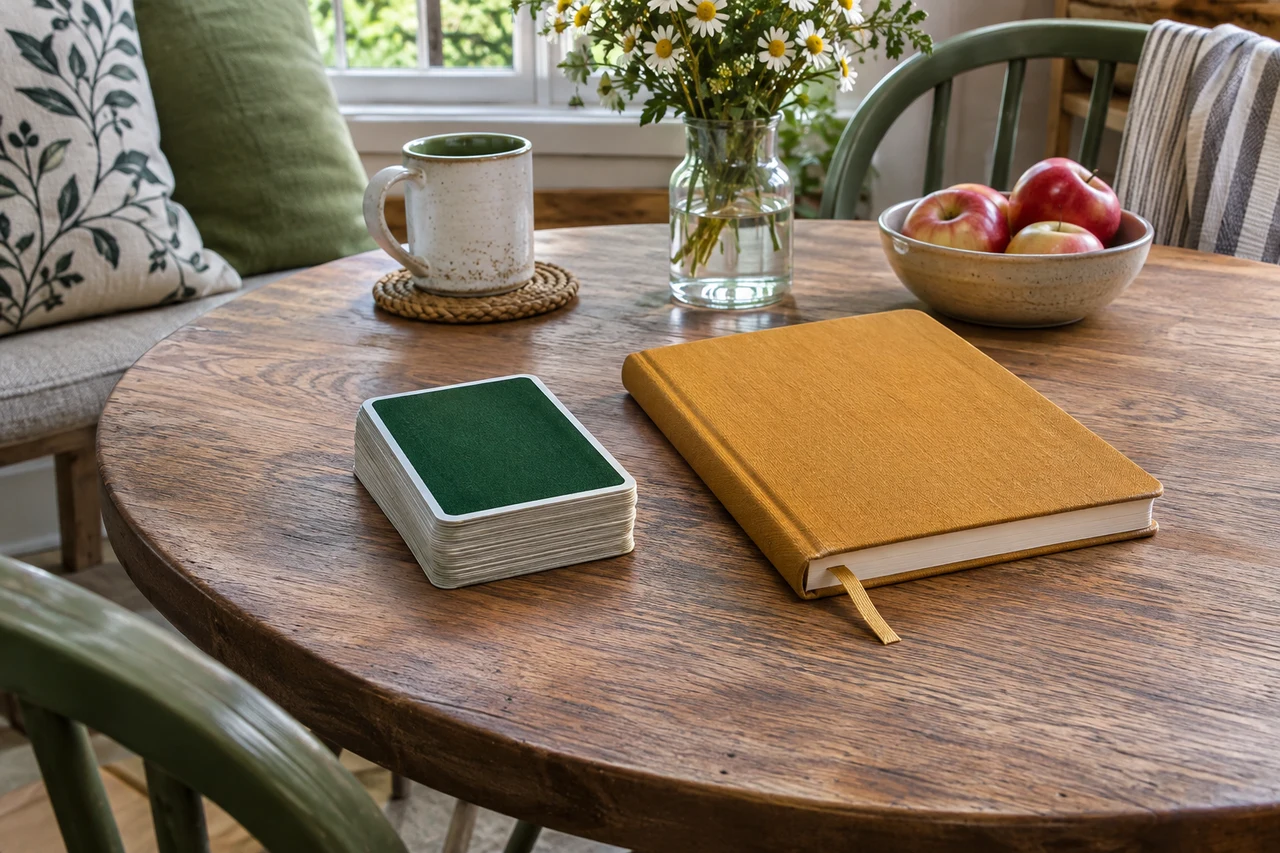
For an original three-person table arrangement, reserve one clear place for stock and a separate adjacent place for discards. Leave each player enough personal area to manage a private hand. Use the actual furniture and cards to check visibility and access rather than rely on an idealized diagram.
Decide whether the first hand is practice before dealing. A teaching pause can then return to the chosen rule without pretending that a scored choice has already been settled. If playing another hand with points, agree how records will be kept and when the session ends; a notebook does not define an unstated tournament format.
An ordinary deck may already answer the need
Check the deck actually available: completeness, readable ranks and a format the participants can manage. This article has not compared card finishes, tested holders or established an age or learning benefit. There is no need to buy a themed pack merely because the game has a name.
After an actual session, ask which difficulty really occurred. A holder might be worth investigating if managing a hand was difficult; it is unnecessary if the issue was an unclear explanation. Keep scoring about the game’s points, without stakes. The best purchase decision may be to use the suitable deck already in the drawer.
Sources & further reading
Published sources for the details and examples discussed in this story.