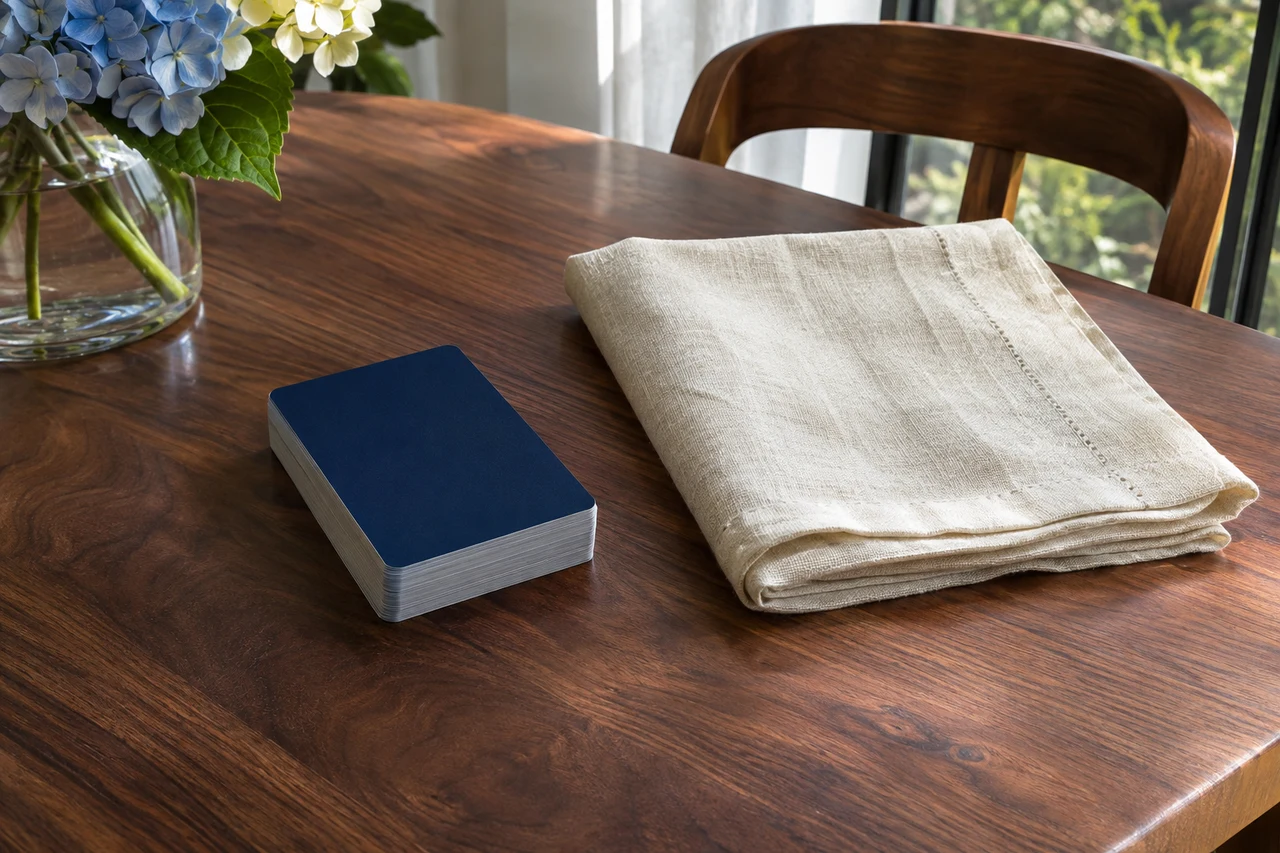
A card game can use the table as its playing space rather than giving everyone a private hand. This proposal follows Bicycle’s published Concentration rules with a standard 52-card pack. Our two-player table arrangement is a hosting suggestion, not a played experiment or evidence of a memory benefit.
Give every card a settled position
Choose a table that can hold all 52 cards face down without touching, including at their corners. Clear unrelated objects first. The published version spreads the pack across the table; a purchased grid or special matching-card set is unnecessary. Use an ordinary complete deck whose backs do not identify individual cards.
Before shuffling, agree who goes first and which side of the table each person will use. Leave somewhere separate for collected pairs so they do not become confused with the face-down playing area. Nobody receives a private hand. Avoid starting on a surface that will need to be cleared for dinner halfway through the game.
Make both reveals part of one turn
Bicycle’s objective is to collect pairs of the same rank. On a turn, reveal two cards, leaving the first face up while turning the second. A matching pair goes face down into that player’s collected pile, and that player continues. After a nonmatch, pause at least five seconds, turn both face down in exactly their previous positions and pass left. Continue until every card has been matched. The greatest number of pairs wins.
Two sixes match even when their suits differ. Two cards sharing a suit but having different ranks do not. Keep that distinction explicit before beginning, rather than changing the matching criterion when an attractive combination appears. The pause belongs to an unsuccessful turn; it is not a new scoring category.
Keep demonstrations off the actual layout
If the group wants an explanation, use a separate small demonstration before shuffling the real pack. Show one rank match and one nonmatch, including the return to the same places. Then put every card back into the complete deck before the actual deal. This avoids leaving a demonstration pair already credited to someone.
During the game, do not tidy the remaining cards into a smaller area after pairs disappear. Their positions are part of the published return rule. Ask participants to reach without sliding neighboring cards; if the layout is beyond comfortable reach, address the table arrangement before starting rather than inventing an advantage for the person nearest the middle.
Count pairs without inventing a playoff
A complete 52-card pack produces 26 collected pairs. At the end, count pairs rather than individual cards and check that the two players’ totals sum to 26. A split of 13 pairs each has no sole greatest total. Bicycle supplies no separate tiebreak in the cited rules, so this article does not add a sudden-death reveal, speed contest or bonus point.
Before buying a dedicated matching game, decide whether the ordinary deck and a suitable table already provide the evening you want. A more decorative deck does not establish a different difficulty or measured benefit. Pack the complete deck away after counting; a proposed second game begins with a new shuffle and a fresh layout, not with the previous winner’s collected pile.
Sources & further reading
Published sources for the details and examples discussed in this story.