
Two people sharing a lap lane do not necessarily follow the same pattern as three. The City of Alexandria, Virginia, gives a specific distinction on its Aquatics Facilities page: two swimmers split a lane, each staying on one side; three or more circle swim counterclockwise, always staying to their right. The page also asks swimmers to let others know they are entering. Reading those instructions together matters when an apparently spare half-lane is about to become a different shared arrangement.
Start with the lane assigned to the actual activity
The City says lap swimming is first-come, first-served on a drop-in basis. That does not mean every visible lane is available for lap swimming. Its guidance separately explains that lanes and zones are designated for lap swim, open swim, programs and rentals, and that staff can help visitors find a suitable lane or zone.
For a hypothetical visit, imagine Alex and Bea already sharing a lane designated for lap swimming. A third swimmer, Cam, arrives. The first question is not how Cam can fit around whatever the other two happen to be doing. The relevant City rule changes the shared pattern when the number becomes three.
This is a reading of the named provider's published instructions. No particular pool session, current lane availability or swimmer has been observed. The article does not assess anyone's swimming ability or replace the staff's directions at the actual facility. Those limits keep the lane diagram from becoming a homemade admission or readiness test.
With two swimmers, preserve each person's side
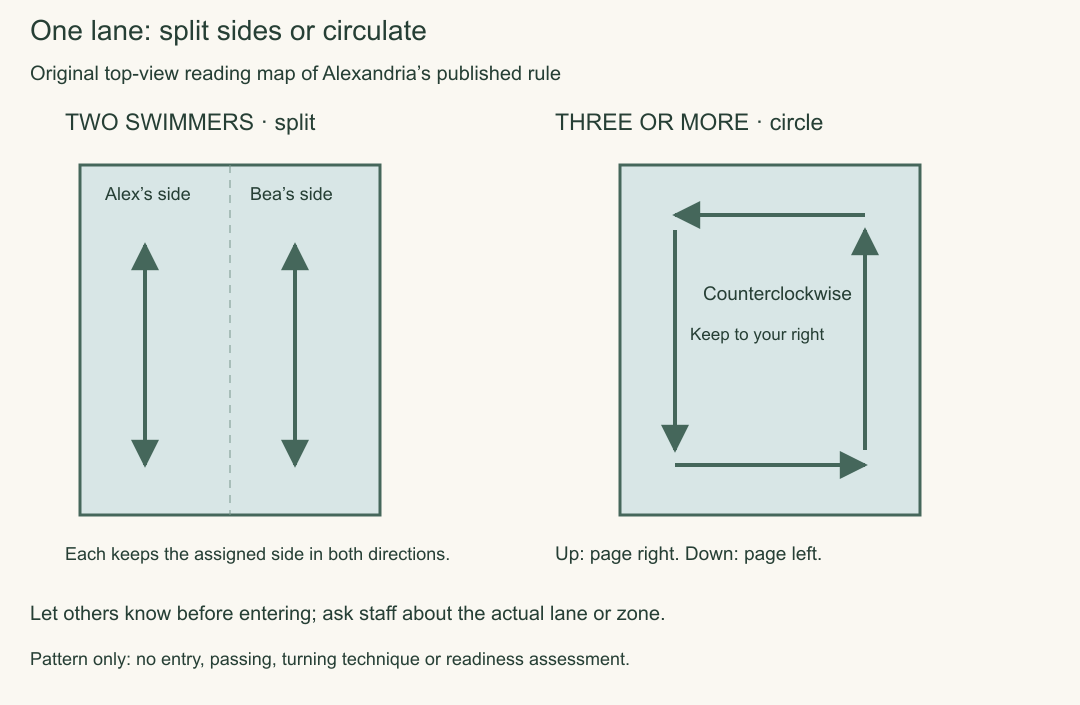
In the original two-person plan, Alex uses one half of the lane and Bea uses the other. Each stays on that side for travel in either direction. The diagram shows two distinct side assignments rather than a single circulating route. The names and positions are fictional; the purpose is to make splitting visible.
A dashed center line in the drawing identifies the halves. It is a graphic aid, not a claim that the actual pool has that exact marking. Likewise, the arrows describe the intended pattern, not the technique for turning, passing, pushing off or entering the water. Those practical questions belong with appropriate pool instruction and staff guidance.
The important distinction is the relationship between the people and the sides. The side remains assigned to the same person. A sketch that sent Alex up one side and back on Bea's side would show a different pattern from the split being explained.
With three or more, read right relative to travel
The City's three-or-more instruction is counterclockwise circle swimming, with each swimmer staying to their right. In the top-view diagram, an upward journey follows the right edge of the lane; the downward journey follows the left edge of the page. On that return journey, the page's left is still the swimmer's right because the swimmer is facing the opposite direction.
That change of viewpoint is the reason to keep a directional diagram beside the words. Right does not mean one permanently selected page edge for every journey. Nor does adding Cam mean giving three people fixed thirds of the lane. The published pattern is a circulating one.
The drawing keeps its orientation explicit and uses one loop to represent the arrangement. It does not assign distances between people or a passing procedure that the City passage does not provide. If the actual group cannot agree how the published pattern applies, ask staff rather than inventing a negotiation in the middle of the lane.
Notify before treating the new pattern as understood
Return to the fictional moment when Cam arrives. A useful enquiry would be: “I would like to join this lap lane. Shall we confirm the three-person circle pattern with staff?” This is an original conversation prompt built around the City's notification instruction, not a transcript from a pool. The notification instruction applies when joining either arrangement, not only the three-person example.
Do not presume the other swimmers have noticed a new arrival or that a silent change in direction will communicate the plan. The number, the intended pattern and any staff instructions need to be understood by the people actually sharing the lane. A web page cannot confirm that communication has happened.
I would keep the two diagrams as a vocabulary aid before a visit: two means split sides in this City guidance; three or more means counterclockwise circulation. Equipment purchases do not settle that coordination. The useful next action is to ask about the actual lane and make the shared arrangement explicit, while leaving swimming skills and any unresolved facility procedure to the appropriate people.
Sources & further reading
Published sources for the details and examples discussed in this story.