A shared market table can offer two makers' work without becoming one shop. A customer who picks up a notebook and a print needs to know whose items they are holding, where each payment goes and which seller can answer a later question. That distinction belongs in the arrangement before the first visitor approaches the table. Renegade Craft's Booth Shares guidance supplies a real organizer context: sharing depends on accepted participants and the event's actual footprint, and partners are asked to coordinate beforehand. The two independent businesses below are invented. Their separate checkouts and signs are an original plan, not a payment rule imposed by Renegade or a statement about tax, partnership or liability.
Give the shared space two clear seller identities
Imagine Mara Paper bringing notebooks and Ivo Prints bringing small art prints. The chosen arrangement has each business selling its own products and taking its own payments. A person browsing should be able to connect an item to one of those names without memorizing which maker usually stands on which side.
Place a small seller heading with each product group. The notebook label can read “Mara Paper — notebooks,” while the print group reads “Ivo Prints — prints.” Carry the same name onto the relevant price card and packaging note. If a spare print moves near the notebook stack during a busy conversation, its identity should move with it.
The plan does not require every product to have an elaborate custom tag. The important relation is between the actual item, its price information and the responsible seller. A handwritten card can expose an ambiguity before money is involved. Matching decorative lettering across both sides is secondary to making those identities readable.
Use the actual allocated space when placing the headings. Renegade lists several possible half-booth dimensions and says these depend on the event; no single size applies to every shared booking. Two attractive sketches do not establish that the organizer has supplied two tables or an extra aisle. Agree the workable arrangement within the confirmed footprint.
Follow one mixed selection through two sales
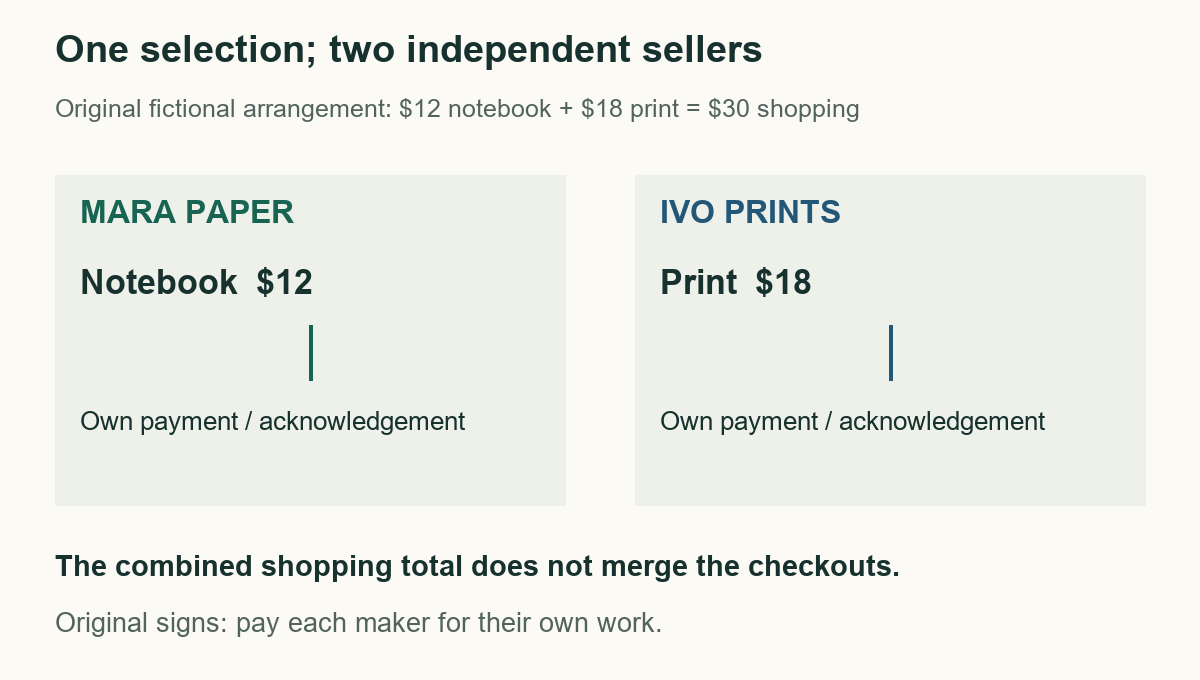
A fictional customer chooses a $12 notebook from Mara and an $18 print from Ivo. Under the partners' separate-checkout plan, the purchase involves $30 in total but two payments: $12 to Mara Paper and $18 to Ivo Prints. The customer's shopping total is not a reason to send all $30 to whichever payment device happens to be closest.
A simple shared sign could read: “Two independent makers share this table. Please pay each maker for their own work.” At the notebook checkout, a smaller note says “Mara Paper purchases here”; the other says “Ivo Prints purchases here.” Those are original wording examples. Use the actual business names and the payment methods each business has established, rather than displaying a service neither seller can accept.
Now rehearse what happens when the customer places both items in one pile. Mara can identify the notebook, give its $12 total and point out that Ivo handles the print's separate $18 transaction. The point is to explain the arrangement before an ambiguous payment, not to make the customer discover the split after receiving one unexplained charge.
If the makers instead want one combined checkout, this example no longer describes their setup. They would first need to resolve the actual commercial and payment-service arrangement. Do not improvise a combined sale by collecting a partner's payment and promising to sort the accounts out later. A shared table alone does not answer who is selling what.
Let the acknowledgement lead back to the seller
After the notebook payment, any acknowledgement should identify Mara Paper's transaction. The print's acknowledgement should lead to Ivo Prints. In our invented example, a customer holding two acknowledgements can relate $12 to the notebook and $18 to the print. A shared decorative stamp bearing only the event name would leave that relation unclear.
Keep an agreed way to reach each business with its own product. If the print has a production issue later, the customer should not have to find Mara merely because she was standing nearer the aisle. This is a communication design choice; it does not replace the actual seller's applicable policies or establish a universal return entitlement.
A gift bag containing both purchases can still carry two seller cards. Packaging the items together for convenience does not have to erase their identities. Conversely, there is no need to buy matching bags merely to make the table look like one brand. The packaging should preserve the useful information the signs established.
Rehearse the awkward minute before event day
One maker needs a short break while the other is answering a customer. Agree in advance what can be explained, what can be handed over and what must wait for the responsible seller. Do not assume that sharing a footprint supplies permission to use another person's account, equipment or customer records.
Run the $12-and-$18 example aloud. Then move one item across the table and try it again. If the identity becomes unclear, revise the label or product grouping before purchasing more display furniture. Renegade's request to communicate with a booth partner is practical here: the partners need the same explanation, even while remaining two distinct businesses.
Sources & further reading
Published sources for the details and examples discussed in this story.