
Ten notebooks can be sitting on a shelf while only six are available for a new customer. The missing four have not necessarily disappeared. Some may already belong to unfulfilled orders, while another is being kept out of sale. Counting the objects answers where they are; checking their state answers which ones can still be offered. Consider a fictional shop with ten identical blue notebooks at one location. Three are assigned to paid orders awaiting collection, and one has a damaged cover. The other six have no commitment or restriction. Give the notebooks temporary worksheet numbers from one to ten so that each quantity can be traced to a reason.
Give each of the ten a place in the record
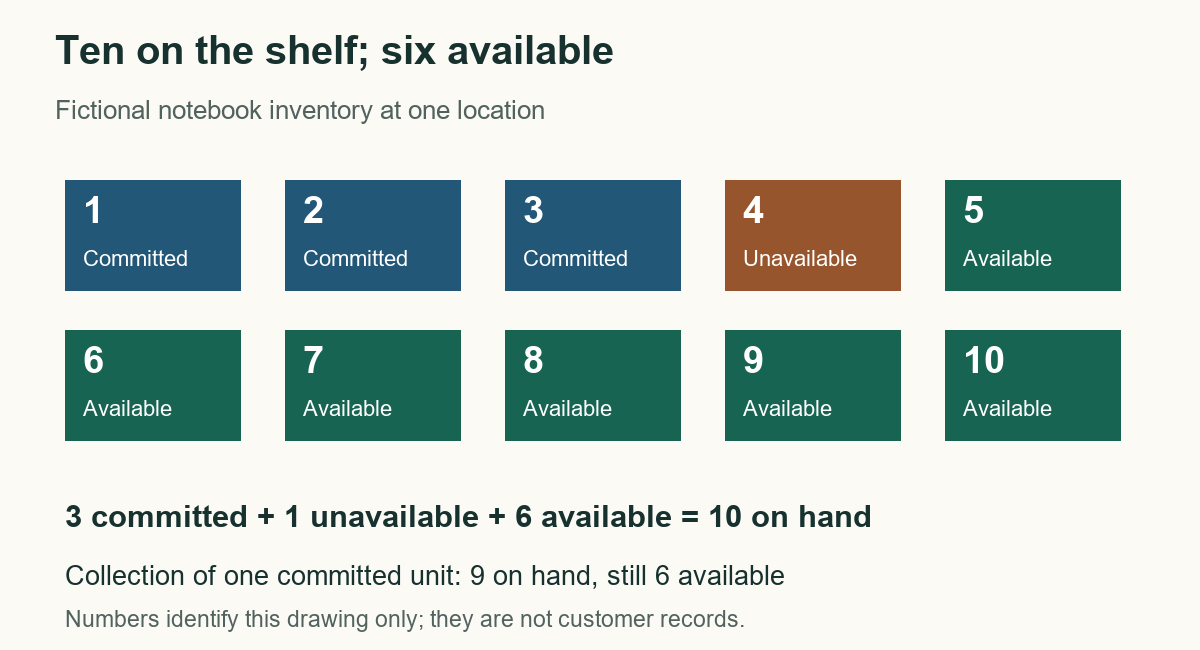
Assign numbers one through three to the three collection orders. Set number four aside for its damaged cover. Numbers five through ten are the six available notebooks. The physical count is still ten: three committed, one unavailable and six available. The numbered drawing below represents this example, not a stock recommendation or an actual retailer's inventory.
Shopify's published inventory vocabulary makes this distinction explicit. Its On hand total combines Committed, Unavailable and Available quantities at a location. Committed includes units in unfulfilled orders and inventory reserved for draft orders; Unavailable covers other reasons for setting stock aside, including damage or quality control. Available excludes those groups. These are the platform's defined states, which should not be silently substituted for another system's labels.
A useful manual record can therefore name both the quantity and its reason: “Three blue notebooks, collection orders A, B and C” is clearer than “three reserved.” Keep customer details in the shop's appropriate private system. The quantity worksheet needs a usable reference, not a public list of customers.
Collection changes the location as well as the promise
Now suppose order A is collected. One committed notebook leaves the shop. Under the example's assumptions, the physical count becomes nine, the committed quantity becomes two, the unavailable quantity stays one and the available quantity stays six. Completing an existing collection has not created an extra notebook for another sale.
That is the important comparison. Before collection: ten on hand and six available. After collection: nine on hand and six available. A shop that reduces available stock again at collection, despite having already allocated the order, would count the same commitment twice in this worksheet. Check how the actual order and inventory system handles fulfillment before making an adjustment.
Keep the collection reference with the movement. If a staff member sees nine objects but a worksheet still says ten, that reference explains the change. A corrected physical count without the corresponding order movement leaves the reason hidden; an order marked collected while the notebook remains on the collection shelf creates a different question to investigate.
A canceled order is a different movement
Consider an alternative to that collection: order A is canceled before its notebook leaves. If the shop has actually released the unit for sale and it has no other restriction, on hand remains ten, committed becomes two, unavailable remains one and available becomes seven. Nothing new arrived. One existing notebook changed state.
The phrase “if the shop has actually released the unit” matters. A message asking to cancel is not a reason to guess what the system now records. Confirm the order's actual status and any remaining hold. This example does not assume that a reservation disappears after a particular number of hours or that payment and stock adjustments happen together.
The damaged notebook provides another distinct possibility. If its condition is resolved and the shop makes it available, one unit moves from unavailable to available without changing the physical total. If it is removed from the location instead, the physical total changes. Write down which event happened; the same increase in sellable stock cannot be assumed in both cases.
Keep an incoming carton outside the shelf count
Suppose a supplier also says that four more notebooks are on their way. Those four are not part of the ten physically counted. Shopify describes Incoming separately and excludes it from Available until receipt and the applicable state change. It also notes that apps can place received units into another state, such as unavailable safety stock.
For the original ten-notebook position, the record remains ten on hand and six available, plus four incoming. It is not fourteen on hand simply because a shipment is expected. When the four are actually received, checked and made available in this hypothetical shop, the new totals would be fourteen on hand, three committed, one unavailable and ten available.
Use that last sentence only with its stated assumptions. The shipment might contain a different variant, a damaged unit or fewer notebooks. Receipt is the point to establish what arrived, not to preserve a number copied from an expected-delivery message. An incoming quantity is useful precisely because it does not pretend the receiving work is already complete.
Sources & further reading
Published sources for the details and examples discussed in this story.