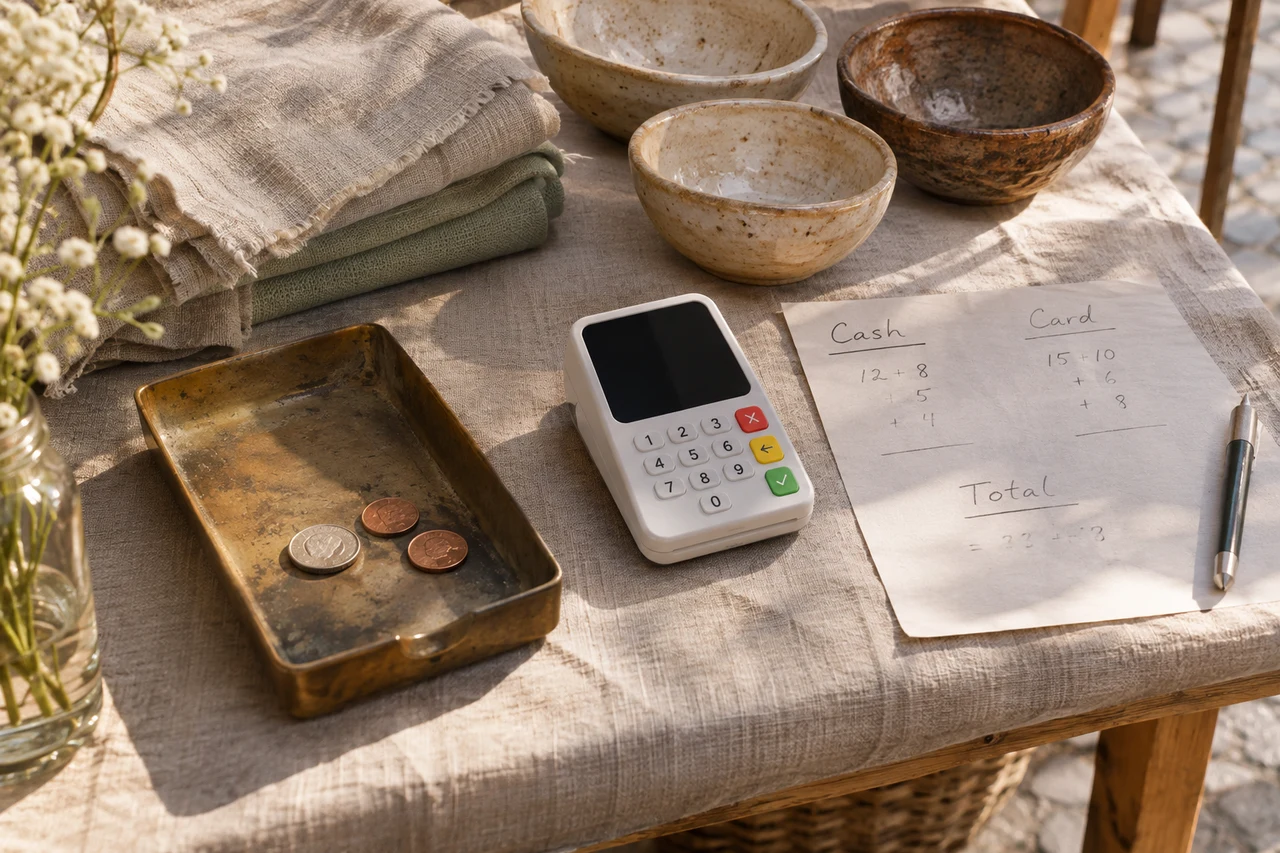
At the end of a market, the cash box, card report and bank account can show three different amounts without any money being missing. They describe different parts of the day. A useful closing sheet connects those parts while leaving the opening float out of sales. Start with one event, one currency and a stated cutoff, then follow each payment channel to where its money actually sits. The following dollar amounts are a fictional worked example, including the fee. It assumes completed payments, no taxes, tips, discounts, gift cards or unpaid orders, and no other money added or removed. These assumptions keep the calculation visible; they are not a fee quote or a complete business accounting model.
Write the day's inputs before calculating a total
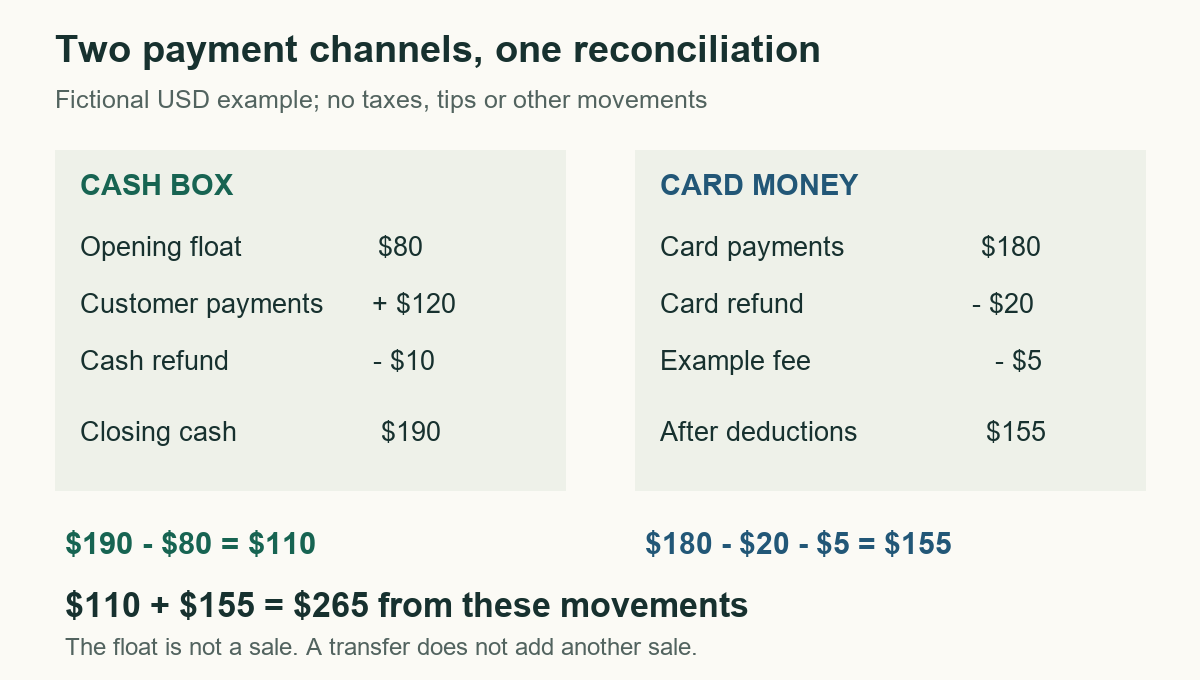
Imagine a stationery stall beginning with an $80 cash float. During the event, customers pay $120 in cash and $180 by card. The stall later returns $10 in cash and refunds $20 to cards. The example's card statement shows a $5 processing fee deducted from the card money. Keep the five movements separate: cash payments, cash refunds, card payments, card refunds and card fees.
Before refunds, customer payments total $300: $120 plus $180. Calling that the example's pre-refund sales figure says what the number includes. It does not mean that every reporting service uses the same heading for that amount. The $80 opening float belongs on its own line because it was already the stallholder's money before the first customer arrived.
Record the event date and the report period beside the figures. A card refund processed the next morning belongs to a different reporting window unless the worksheet deliberately includes it. Moving that refund into yesterday's figures without marking the change creates a difference that looks like an arithmetic error but is really a cutoff problem.
Count what should be in the cash box
The expected closing cash is $190: the $80 opening float, plus $120 received from customers, minus the $10 cash refund. Count the actual notes and coins separately, then compare that count with $190. The cash contribution from the example's trading is $110, found by subtracting the opening $80 from the closing $190.
Suppose the first physical count is $188. Write down a $2 difference rather than changing cash sales to make the numbers agree. Recount, then look for a recorded cash movement that was missed: a refund entered twice, for example, or money removed from the box. A discovered $2 removal would need its own record. If no explanation is established, the difference stays visible.
This closing calculation answers a different question from choosing useful denominations before opening. A box can have the correct $190 total and still contain an awkward mix of notes. Keep the denomination count as supporting detail; use the closing sheet to connect the actual movements with the total counted.
Follow the card money through the deduction
Card customers paid $180, and $20 went back through card refunds. That leaves $160 before the example's $5 fee, or $155 after it. The worksheet can therefore expect a $155 transfer if that exact group of transactions and the one stated fee make up the transfer. The transfer is the destination of those receipts, not a new sale.
Do not add the $180 card payments and the $155 transfer together as though two customers paid those amounts. One is the starting collection figure; the other is what remains after the stated deductions. If the $155 has not reached the bank at the closing cutoff, show it as awaiting the matching bank entry rather than writing that the bank already received it.
For a real service, match the actual transaction group, refunds, deductions and transfer reference. A bank entry combining several trading days cannot be compared directly with one event's card payments. Equally, a fee that is billed separately would require a different flow from the deduction assumed here. The records determine the calculation, not the desire to end with one convenient number.
Bring the two channels back together
After refunds, the example has $270 of customer receipts: $300 less $30. After the $5 fee, $265 remains from these movements. The cash side contributes $110 and the card side $155, which also total $265. That second route checks the first without counting the float or transfer twice.
Another check begins with the money locations. Closing cash of $190 plus card money after deductions of $155 equals $345. Subtract the $80 that was there before trading and the result is again $265. Label the locations carefully: card money awaiting transfer is not the same as a confirmed bank balance.
None of these totals is profit. The example has not deducted the notebooks, stall fee or other business costs. A tidy payment reconciliation shows that the stated receipts and deductions connect; it does not establish how much the event earned after all expenses.
Match the report's definitions and leave a usable trail
Square's US reporting guidance provides a practical reason to read headings carefully: reporting methods and timing can differ, open checks can affect the sales summary, and transactions need to be completed and settled for an accurate comparison. Its payment-method metrics distinguish payment amounts, refunds, fees and the net amount. Use the definitions attached to the actual report rather than assigning a familiar meaning to a column name.
Keep the closing sheet with the counted-cash note and the relevant report or transfer reference. A short final entry might read, “Cash counted $190; card amount after the listed refund and fee $155; bank match pending.” Once the bank match is established, record the reference and completion date. The sheet then shows both the calculation and the piece that was still unfinished at closing.
Sources & further reading
Published sources for the details and examples discussed in this story.